How to catch billing issues before your customers do
What cloud billing should auto-catch in mixed services
Managing one utility service can be complicated enough. Add electricity, water, gas, hot water or other services to the same customer base, and the opportunities for billing errors quickly multiply.
For small utility companies, manually checking every meter read, tariff, charge and invoice isn't practical as the business grows. The right cloud utility billing software should do more than calculate bills. It should automatically identify unusual or incomplete billing data before it turns into an incorrect customer invoice.
That is where utility billing automation makes a significant difference. Instead of relying on staff to find problems after invoices have been generated, automated checks can bring exceptions to their attention before billing is completed.
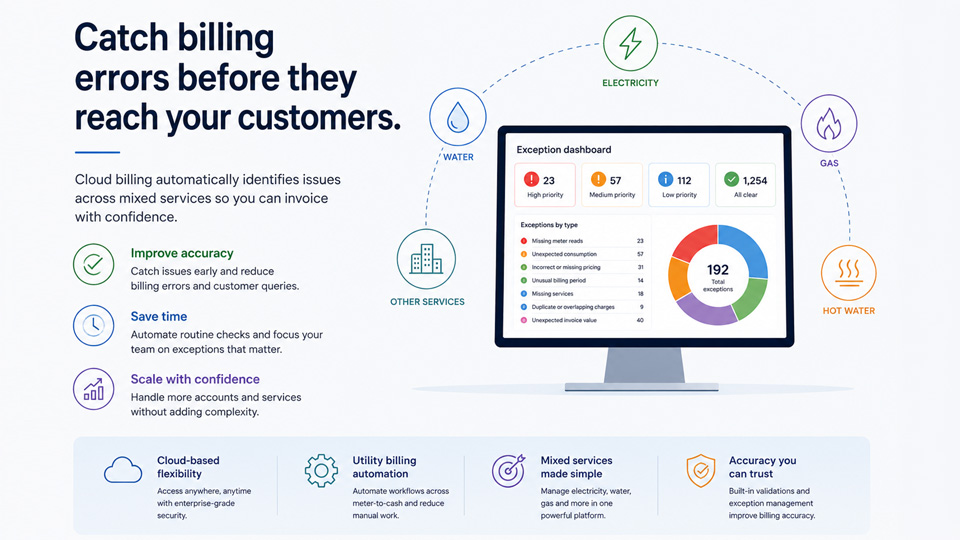
Here are some of the key issues your billing platform should be able to help you catch.
1. Missing meter reads
A missing meter read can delay an entire billing cycle or result in a customer being billed using incomplete or estimated information. This becomes particularly important when customers receive multiple mixed utility services. An electricity read may have arrived, for example, while the corresponding water or gas read is missing. Cloud billing software should help identify:
- missing meter reads
- meters that haven't been read within the expected period
- incomplete meter-read imports
- services without sufficient consumption data for billing
Rather than discovering the problem while investigating an invoice, your billing team can address the exception before invoices are produced.
2. Unexpectedly high or low consumption
Not every unusual meter read is incorrect, but unusual consumption should be easy to identify.
A significant increase or decrease compared with a customer's normal usage could indicate a meter-reading issue, data-entry error, leak, faulty equipment or a genuine change in consumption.
Automated validation allows billing teams to focus their attention on these exceptions rather than manually reviewing every account.
For small utility companies managing thousands of meters, this exception-based approach can significantly improve billing accuracy without requiring the billing team to grow at the same rate as the customer base.
3. Incorrect or missing pricing
Accurate consumption data doesn't guarantee an accurate invoice. The right price also needs to be applied.
A billing system should help identify situations where a service doesn't have the pricing information required to calculate the bill correctly. This can be particularly valuable in mixed-service environments where different buildings, customers, meters and services may be subject to different pricing structures.
Automated checks provide another layer of protection before invoices reach customers.
4. Unusual billing periods
Incorrect billing dates can produce unexpected charges even when the meter reads and rates themselves are correct. For example, a customer might inadvertently be billed for a much longer or shorter period than usual.
Your cloud utility billing software should make unusual billing periods visible so they can be investigated before invoices are finalised. This is especially useful when different services operate on different meter-reading or billing cycles.
5. Missing services
Mixed-service billing creates another challenge: determining whether everything that should be billed actually has been billed. A customer may receive electricity and water, for example, but only the electricity service is ready for billing. Without appropriate controls, the missing water charge may not be immediately obvious. Effective utility billing automation should help teams identify incomplete billing and service exceptions rather than assuming that an invoice is correct simply because it was successfully generated.
6. Duplicate or overlapping charges
Duplicate charges can arise from manual entry, recurring charges, data imports or changes to account configurations.
Automated billing controls should help reduce the risk of the same consumption or charge being billed twice. The objective isn't simply faster automated invoicing. It is automation with controls around it.
Generating thousands of invoices quickly provides little benefit if your team then needs to spend hours checking whether those invoices are correct.
7. Unexpected invoice values
Sometimes the easiest indication of a problem is the invoice total itself. An invoice that is substantially higher or lower than expected deserves attention, even when the underlying data initially appears valid. Cloud billing platforms can use exception-based workflows to help identify invoices outside expected parameters, giving billing teams an opportunity to investigate before they're issued.
This changes the billing process from:
Generate → Send → Find errors
to:
Generate → Validate exceptions → Review → Send
For customers, that can mean fewer unexpected bills and subsequent adjustments. For billing teams, it means less time spent correcting avoidable problems.
Accuracy at scale for small utility companies
Small utility companies often reach a point where processes that worked for hundreds of customers become difficult to maintain across thousands. Spreadsheets, manual checks and knowledge held by individual team members can become bottlenecks. Cloud billing provides an opportunity to change that operating model.
Instead of asking your team to check everything, your software should perform the repetitive validation and direct people toward the accounts that genuinely require investigation. That is particularly important when billing multiple utility services, where every additional service introduces more data and more opportunities for something to go wrong.
What to look for in cloud utility billing software
When evaluating a billing platform, don't just ask whether it can automate invoices. Ask what it catches before those invoices are sent.
Look for software that can help you identify missing or unusual meter data, pricing issues, incomplete billing, unexpected consumption and invoice exceptions across multiple services.
Most importantly, consider how the platform handles exceptions. Your team should be able to quickly see what requires attention, understand why it has been flagged and resolve the issue without disrupting the entire billing cycle.
Make automation work for your billing team
At Utilmate, we believe automation should remove repetitive work while giving billing teams greater visibility and control. Utilmate's cloud utility billing software helps utility providers manage electricity, water, gas and other services within one platform, with automated billing processes and exception management designed to identify issues that need attention.
For small utility companies, that means spending less time manually checking routine billing and more time resolving the exceptions that matter.
Because the goal isn't simply to send bills faster.
It's to get them right before they're sent.
Catch billing issues before your customers do.
As your customer base grows, manually checking every meter read, charge and invoice becomes increasingly difficult.
Utilmate brings utility billing automation, mixed-service billing and exception management together in one cloud platform, helping your team identify issues before invoices are sent.
Spend less time checking routine billing and more time focusing on the exceptions that need your attention.
BOOK A DEMO REQUEST MORE INFORMATION
Published on Tuesday, August 4, 2026